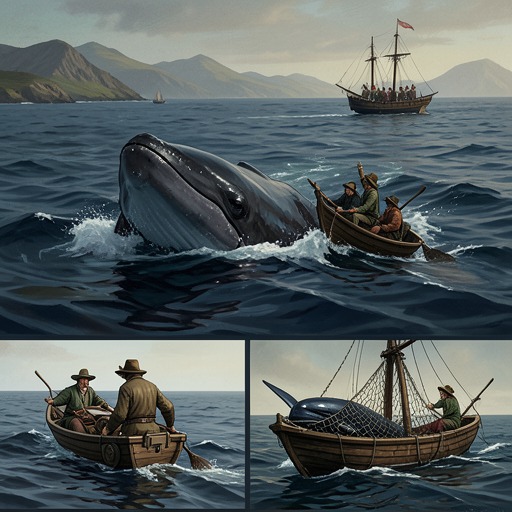
American-style whaleboat
The WhaleThe American-style whaleboat was the whaling crew’s small, fast hunting craft: a thirty-foot vessel designed to bring a handful of men close enough to attack a whale. Its grace and efficiency were inseparable from its exposure. The boat could slip across the water almost silently, but it was slight enough to be carried by three men and vulnerable enough to be smashed in an encounter with the animal it pursued. It was neither a miniature ship nor a place of safety, but a precision instrument whose design drew human skill and whale power into unnervingly close contact.
Construction and Maneuverability
The boat’s double-ended form allowed it to be rowed in either direction, making it exceptionally maneuverable during a chase. Its cedar, clinker-built sides and eighteen-foot oars combined lightness with a hull intended to move quickly through the water. The six-man crew propelled it with long strokes; its narrow, sharp-pointed shape was made to pass through the sea rather than push heavily against it. The description of the craft as buoyant and graceful emphasizes motion as a defining quality: it seemed to dance across waves, not plough through them.
That lightness had a practical limit. The American-style whaleboat was slight enough that three men could carry it, but its delicacy also made it precarious when the pursuit became an affray. Its construction did not protect the crew from the whale’s size or strength. The same responsiveness that let the boat approach quickly left little margin for error once the animal turned or struck. In this sense, maneuverability was not the opposite of danger; it was the means by which the crew deliberately entered danger.
A Craft Designed for the Approach
The boat’s equipment and the crew’s movements were organized around stealth. Rowlocks were muffled to quiet the oars, and the men went shoeless so that they would not alarm the whale. At the stern, the mate held a large steering oar and directed the crew, while the harpooneer occupied the prow with the iron ready. The arrangement divided the work between propulsion, control, and attack, turning a small boat into a coordinated hunting unit.
Speed mattered, but so did restraint. Once the boats had been lowered and drawn near, the oars could be put aside while the crew waited. A whale might remain below the surface for ten minutes or an hour; experienced whalers estimated the wait from its size, allowing roughly a minute for each foot of whale. Its return to the surface brought it back within reach, but the angled blow that marked its renewed breathing also exposed its location. The boat’s task was therefore not simply to overtake an animal. It had to get close, remain quiet, and exploit a brief opportunity without provoking the whale too soon.
The approach depended on reading the animal’s field of vision. A direct approach from the front or rear could take advantage of its blind spots, while coming from the side risked being seen. As the boat crept forward, the crew could glimpse the immense flukes beneath the surface. Their careful positioning contrasts with the blunt force of the final encounter: the craft brought men within striking distance, but could not make the whale predictable or safe.
The Crew, the Harpoon, and the Risk
The boat’s shape concentrated danger at its prow. Before throwing, the harpooneer rose and braced himself against a semicircular cut in the gunwale, known as the clumsy cleat. The boat and weapon became extensions of his reach, while the cleat held his body in position against the movement of the craft. This was a moment of extreme exposure: the hunter had to balance as the boat approached an animal vastly larger and more powerful than himself.
The cleat also makes the boat’s material structure part of the action. It did not merely transport the harpooneer; it gave him a precarious point of support from which to strike. The comparison with Ahab’s peg-leg, fitted into a socket on the deck of the Pequod, links the small craft’s practical fittings to the novel’s larger imagery of bodies joined to wood. In both cases, a human figure is secured to a vessel by a fitted piece of timber, though aboard the whaleboat the arrangement serves an immediate, perilous task.
For inexperienced men, the approach could be overwhelming. Some greenhands fainted at the sight of the whale and had to be replaced by more experienced hands; others became so frightened that they had to be quieted. The danger was not abstract: the crew had to confront the animal from a fragile craft at close range, with the harpooneer expected to act first. The boat’s carefully coordinated design could carry the men to the decisive instant, but it could not remove the fear or equalize the contest.
Literary and Thematic Function
In the account of whaling, the American-style whaleboat stands between admiration for skilled workmanship and recognition of the violence that workmanship serves. Its clean lines, quiet oars, and swift handling show human ingenuity at its most disciplined. Yet every feature is directed toward approaching and attacking a whale, and the boat remains vulnerable to the creature it helps pursue. Its elegance therefore cannot be separated from its function.
The craft also gives the hunt its intimate scale. The whale may be immense, but the encounter is mediated by a small crew in a slight boat, each person assigned a role and exposed to the animal’s power. The contrast between the whale’s vastness and the boat’s delicacy sharpens the sense of risk that runs through the scene. As a literary object, the whaleboat is at once a marvel of practical design and a fragile platform for violence: it carries the hunters toward their target, but its very nearness makes clear how little control they possess.